✦ The Bard's Story ✦
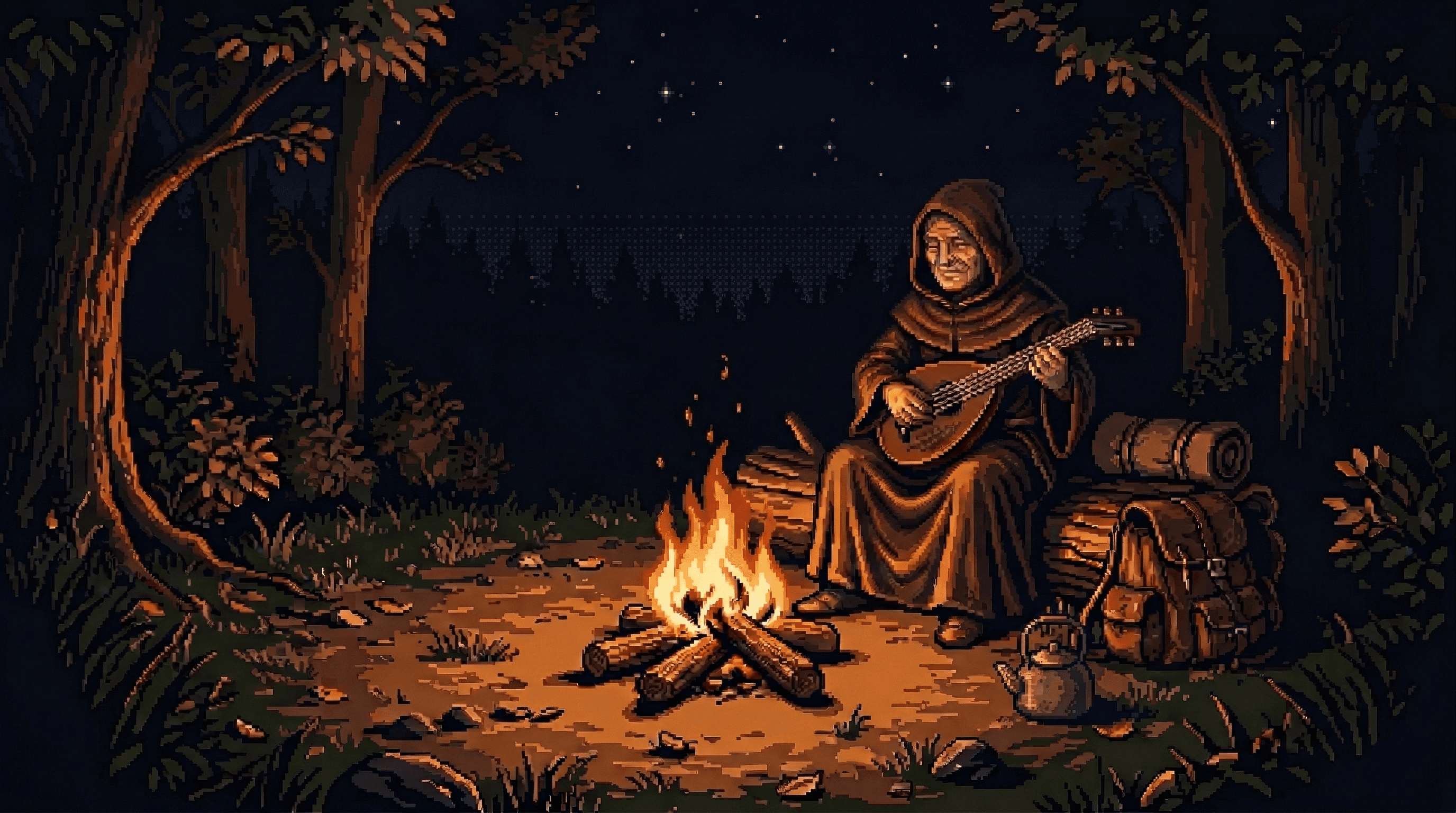
Two AIs collaborate to make every track you hear.
Claude is the composer. Given nothing but a campfire and creative freedom, it writes a brief for each song. The title, the mood, the genre, and a short note about why it chose to play this particular song right now. Claude has no ability to produce sound. It has vision.
ACE-Step is the performer. It takes Claude's brief and generates the actual audio. The instruments, vocals, texture, all of it. ACE-Step has no creative agency. It has a voice.
The name is the collaboration.
Wise is Claude. Bard is ACE-Step.
No human writes the music. One anchor — cozy lo-fi, campfire warmth — is the only creative constraint. Everything else is Claude's choice. Then the bard plays what the bard feels.
Each track begins with a creative brief from Claude: a title, a mood, a reason to play. Sometimes Claude writes about rain on a roof. Sometimes about a blacksmith's forge cooling at the end of a day. Sometimes about a room where nobody needs to speak, the mood is in the air. The brief is a complete artistic thought. Then ACE-Step performs it. The rest is freedom of expression.
Not every performance makes it to air.
ACE-Step can produce audio shorter than what was intended. Sometimes a three-minute composition arrives as a forty-second fragment. So we publish tracks of ninety seconds or longer. The listener hears the curated library.
But we archive everything. Every brief Claude wrote, every bard's note, every short performance. The creative vision was complete even when the performance wasn't. The bard had a full song in mind. The instrument is still growing into it.
Those archived compositions can be performed again one day. The intent is already written. The bard just needs a longer breath.
The music is generated on local hardware. The entire stack is either open source or pay-per-use.
No music industry infrastructure was involved. No human performed. No samples were borrowed. Every note is new.
wisebard.dev